

A Scenic Landscape: Afternoon with Oil Painter Jim Laurino at the Shelton Art League
Today I had the pleasure of attending a painting demonstration at the Shelton Art League led by renowned painter Jim Laurino of Litchfield, Connecticut. I first became familiar with Laurino’s work through Facebook—a platform often used to quietly monitor estranged friends and distant relatives, but which, for me (as a gallerist) has become an unexpected mecca for discovering artists and creators nationwide. The other evening, after only a few moments of scrolling I came across a post announcing today’s demo alongside an image of Jim’s work. I stopped mid-scroll, cleared my calendar, and decided I would be in attendance.
It was a beautiful afternoon, marked by clear skies and a temperature best described as “warm for winter.” The kind of day that invites a long drive accompanied by a good podcast—a perfect backdrop for reconnecting with my love of learning about art and the people who make it.
Though the Shelton Art League does not maintain a permanent space of its own, they have established an accessible and welcoming venue at the Shelton Community Center, located at 41 Church Street. I arrived promptly at 1:00 PM to find the room already full, greeted by the hum of conversation and a hot cup of surprisingly decent coffee placed into my outstretched hand.
By 1:02 PM, Jim had already leapt into action, and by 1:03 PM, the room was alive with questions—an eager audience ready to engage, listen, and learn.
Jim Laurino began painting in his early teens and went on to formally study painting and color theory at the University of Connecticut. Early in his artistic life, he focused on marine subjects and was fortunate to receive foundational instruction from notable painters Carl G. Evers and Christopher Blossom. That early training is still evident in his work today—particularly in his sensitivity to atmosphere, light, and tonal balance—even as his focus has shifted more decisively toward landscape painting.
Over time, Jim developed a lasting interest in painting landscapes, particularly those found throughout New England. He prefers working on location, embracing the challenges of plein air painting. During the demo, he spoke about how much more demanding plein air work can be compared to the studio, yet emphasized that the resulting paintings feel less contrived and far richer in content. Nearly all of his studio paintings, he explained, are executed from field studies made outdoors, preserving the immediacy of firsthand observation.
Jim describes his work as impressionist in style, citing Henri Matisse and Claude Monet as major inspirations. That influence is evident in his prioritization of mood and color over strict realism. His paintings often feature barns, homes, and dense landscapes—familiar scenes rendered with quiet sensitivity rather than spectacle.
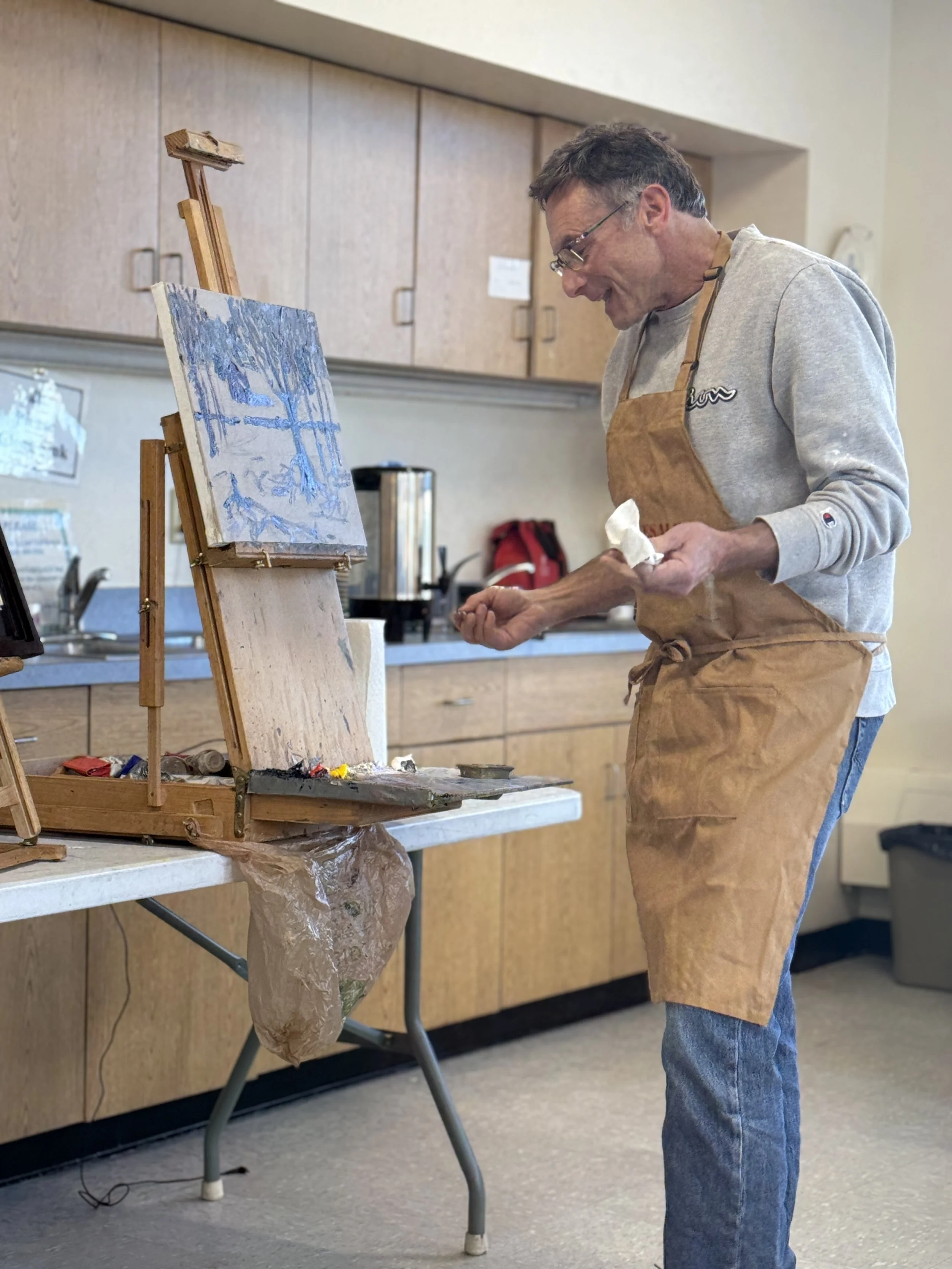
Jim Laurino demo painting at Shelton Art League, January 2026
Though Jim spent the majority of his professional career working in the IT industry, painting was never abandoned. Instead, it evolved alongside his life. When his children were young, he primarily worked in acrylics. Eventually, he transitioned fully into oil painting, working from his home studio while continuing to paint regularly outdoors. He was clear about one thing during the demo: “I never wanted painting to be work.” As a result, he never identified as a full-time artist, despite painting weekly and maintaining a highly active exhibition and plein air schedule.
Watching Jim paint was a lesson in confidence through limitation. He began by describing his surface preparation—gessoing his own canvases and applying a gray primer layer to establish a mid-tone ground. From there, he worked exclusively with a single brush: a #3 Rosemary brand synthetic fiber brush, which he never changed throughout the demo. His palette was equally restrained, consisting of only cadmium red, cadmium yellow, titanium white, and ultramarine blue. From these four colors, he mixed a remarkably nuanced range of muted hues.
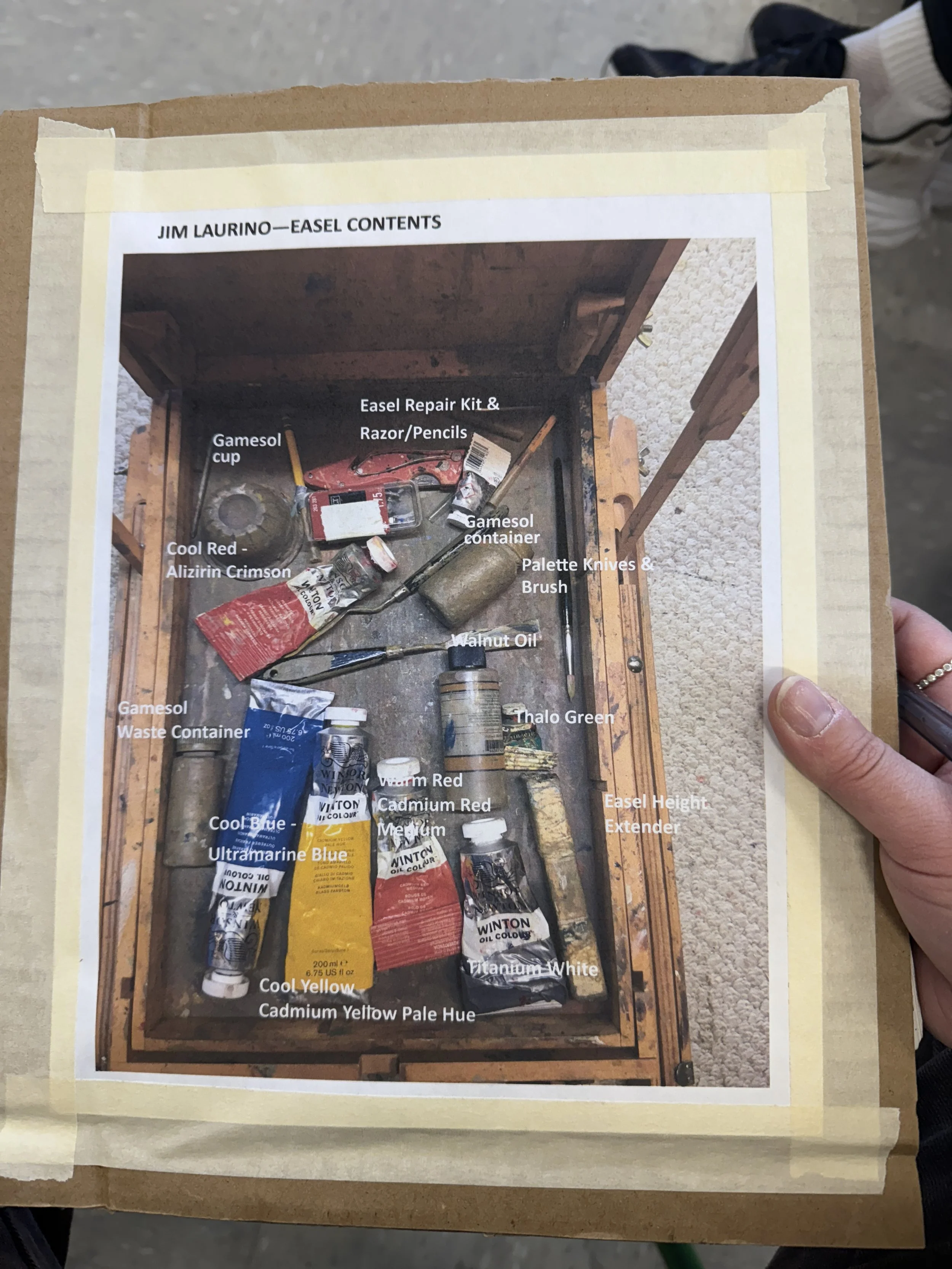
Photo of Painter Jim Laurino’s Suggested/Personal Supplies for Painting
His brushwork was fast and deliberate, composed of quick, short strokes, layered heavily. There was no sense of hesitation —only a steady rhythm of observation and response. Jim emphasized the importance of composition, often beginning with thumbnail sketches to “lock it in” before committing to a full painting. He also shared that he frequently revisits the same composition multiple times, recreating it in various sizes to further explore and refine the idea.
One particularly striking detail was Jim’s approach to framing. He creates custom frames using pieces of antique wood, assembling them into frames that feel as though they’ve lived an entire life before ever holding a painting. From a distance, you’d swear the frames were inherited artifacts, perfectly matched to the subdued, timeless quality of his work.
Jim’s paintings have been juried into numerous regional and national exhibitions, including the RAAM National Exhibit (2022), the AIS National Exhibit (2024), and the Granby Land Trust Open Juried Shows from 2017 through 2024. He regularly travels throughout the country to paint and has participated in many festivals and competitions across the tri-state area and beyond. In 2023, he received the Artists’ Choice Award at the Gloucester Invitational event in Gloucester, Virginia, followed by a Second Prize award there in 2024. That same year, he received the Best Marine Painting Award at Plein Air Easton in Easton, Maryland, and went on to earn First Place at the Adirondack Plein Air Festival in Saranac Lake, New York.
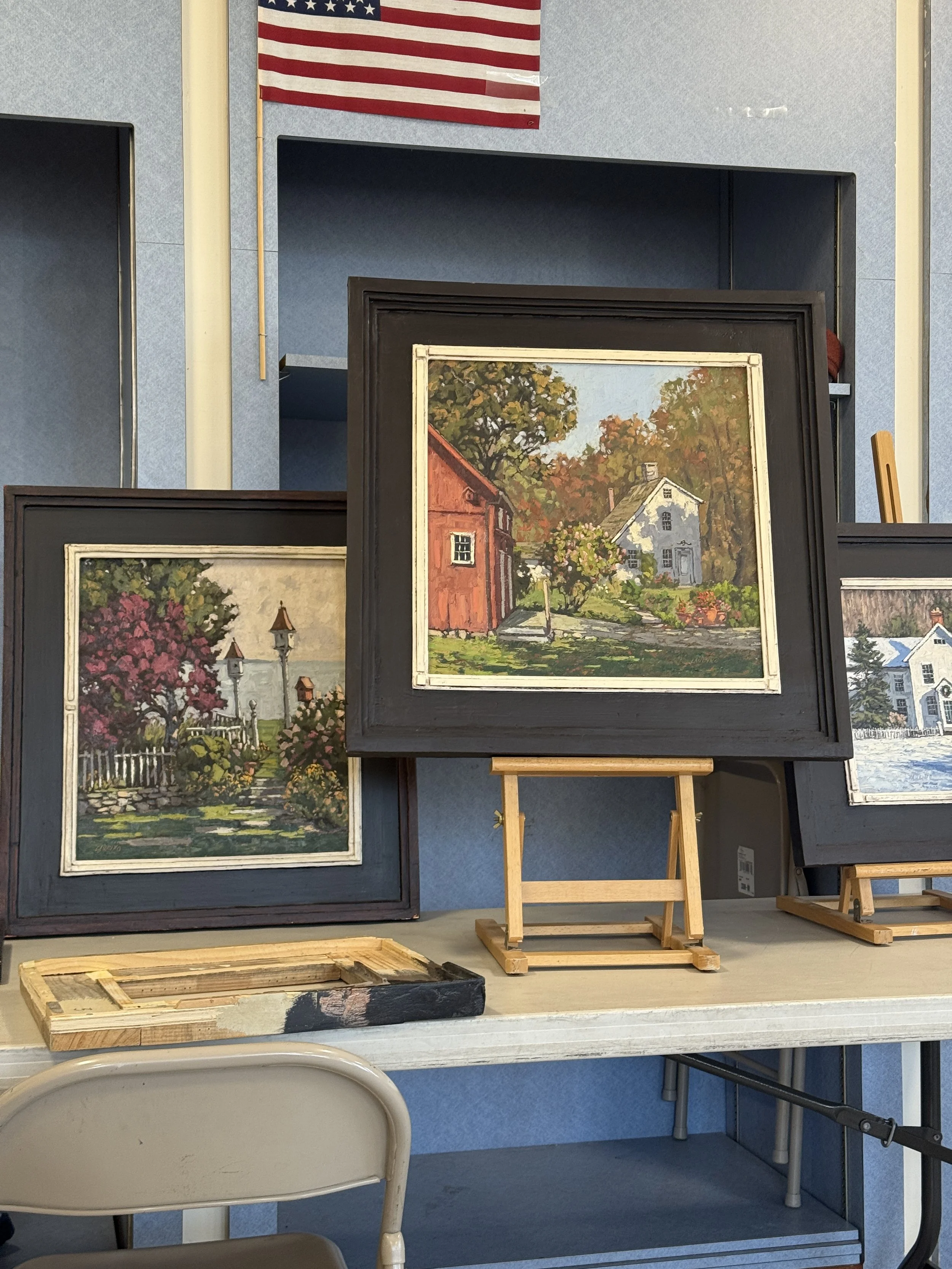
Photo of Jim Laurino’s paintings, January 2026
He frequently shows his work at the Lyme Art Association Gallery in Old Lyme, Connecticut—the birthplace of American Impressionism—where the association’s representational art heritage continues to shape and support contemporary painters. His work is also represented at Alofft Gallery in Litchfield, Susan Powell Gallery in Madison, and Shutterspeed Gallery in Middlebury. Prints and original works can be found at Shutterspeed Photo, and his paintings are often included in Susan Powell Gallery’s themed exhibitions.
By the end of the demo at the Shelton Art League, the finished painting felt like a natural conclusion rather than a performance. Muted, balanced, and thoughtfully composed, it embodied everything Jim had discussed—paintings that are less about spectacle and more about presence. His work ultimately reads as a series of beautifully crafted vignettes of everyday life in New England, made by an artist who has chosen balance, patience, and joy over urgency.
Leaving the demo, I felt not only inspired but reassured. Jim Laurino’s path reminds us that there is no single way to be an artist—and that sometimes the most compelling work comes from simply showing up, week after week, and letting painting remain what it was always meant to be.
Nicole Desanti, Co-Founder, The New Hartford Artisans Guild